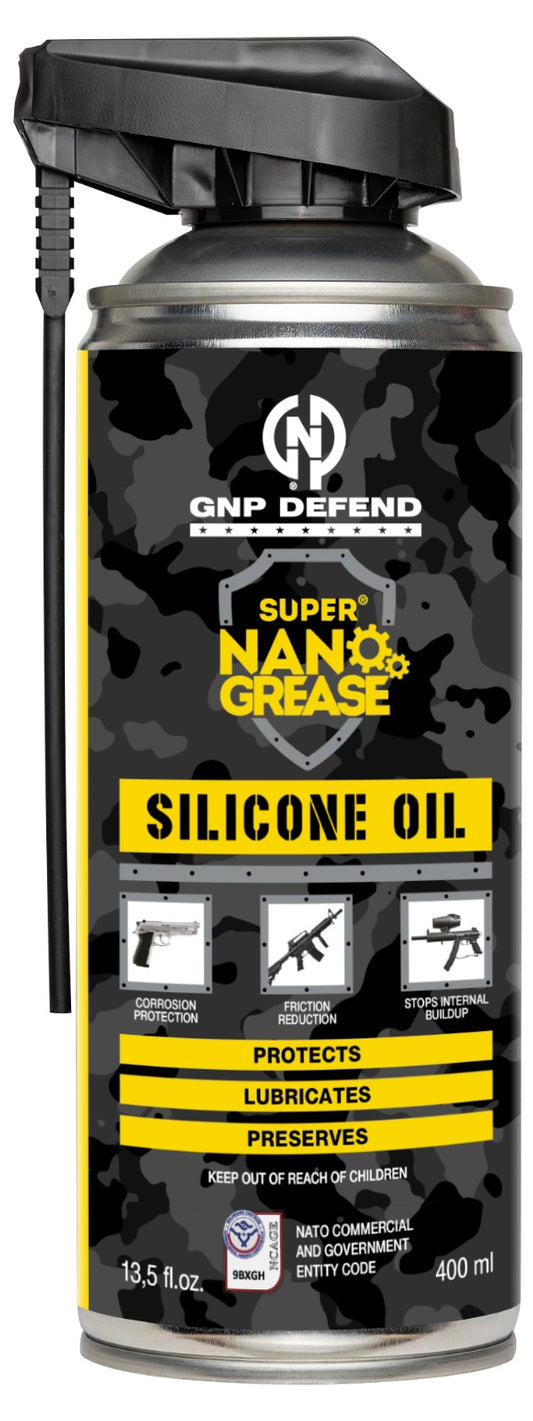
Dry Lube That Runs Cleaner, Cycles Smoother, and Doesn't Attract Dirt.
GNP Defend Dry Lubricant leaves a solid, non-greasy film on metal that won't attract dust, sand, or carbon. Your AR-15 bolt carrier stays cleaner between sessions. Your suppressor threads don't seize. Your firearm cycles reliably even in sub-zero cold where wet oil thickens and fails. Spray it, let it set, run the action — done.
No Dust. No Sand. No Carbon.
Dry film attracts nothing — your gun stays cleaner between range days, period.
Wet oil traps debris. Dry lube doesn't.
Built for American Shooters
Engineered for the way Americans actually use their firearms — range, hunting, carry, training.
By shooters, for shooters.
Works When It's Freezing
Doesn't thicken in cold weather like wet oil. Reliable cycling at temperatures that gum up other lubes.
Tested across NATO temperature ranges.
Suppressor-Safe
Won't bake onto hot threads or varnish into seized connections. Anti-seize behavior built in.
Mount and dismount cleanly.
Safe on Every Finish
Blued, stainless, Parkerized, Cerakote, nitride, polymer. Won't strip coatings or damage finishes.
Test on a hidden area if unsure.
One Coat Lasts
The dry film outlasts wet oil. Reapply every 500–1,000 rounds, not after every session.
Less time cleaning. More time shooting.
Sets in 60 Seconds
Spray it, set it down, the carrier evaporates and the lubricating film bonds. Reassemble and go.
No drying time eating into your day.
Backed by a Real Brand
GNP Defend stands behind every product. Returns honored, questions answered, real support.
Email us. We answer.
Trusted by professionals.
·
NATO NCAGE Coded Supplier
·
WITU Military Tested
·
American-Owned Brand
Why Wet Oil Fails Where Dry Lube Wins
Most gun owners run a wet oil — a liquid lubricant that leaves an oily film on metal. In a controlled environment, wet oil works fine. In the real world, it has two big problems: it attracts every speck of dust and sand around, and it thickens in cold weather to the point where it can actually prevent your firearm from cycling. If you've ever cleaned an AR-15 after a dusty range day and pulled out a BCG covered in black grinding paste, you've seen wet oil's main weakness.
Dry lubricant takes a different approach. After application, the carrier evaporates — what's left is a microscopically thin solid film bonded directly to the metal. No surface tack. No oily residue for debris to stick to. No film to gum up when the temperature drops. The lubrication happens at the molecular level, without the contamination problem that wet oil creates in dirty conditions.
The result for your gun: a bolt carrier that stays cleaner round after round. Suppressor threads that come apart instead of seizing. Reliable cycling on a 20-degree morning hunt when conventional oils thicken and fail. And dramatically less cleaning time after every range session.
The Four Best Uses for Dry Lubricant
Dry lube isn't a universal replacement for every lubricant in your kit. It's a purpose-built tool for specific situations where wet oil falls short. These are the four scenarios where switching to dry lube produces an immediate, noticeable improvement:
1. AR-15 Bolt Carrier Groups
The BCG is the dirtiest part of any AR-15. Gas blowback dumps carbon directly onto the bolt, cam pin, and gas key — and wet oil traps every bit of it. That carbon-loaded oil then grinds against bearing surfaces. Dry lubricant reduces carbon adhesion at the source, so the BCG runs cleaner through long sessions and wipes down dramatically faster after the range. If you shoot AR-15s regularly, this is probably the single biggest reason to switch.
2. Suppressor Threads and Internal Components
Suppressor threads see brutal heat and pressure. Wet oil burns off, varnishes onto threads, and creates seized connections you need a wrench to break. Dry lube functions as an anti-seize — your suppressor comes off the host cleanly every time. Inside the can, dry lube also reduces carbon buildup on baffles. Anyone running suppressors regularly, especially on rimfire or short-barrel platforms, should be using dry lube on threads.
3. Cold-Weather Hunting and Training
Conventional gun oils thicken below freezing. In genuinely cold conditions — a December deer stand, winter training, January coyote hunts — wet oil can be thick enough that your firearm doesn't cycle reliably. Dry lubricant doesn't have that problem. The film stays functional from sub-zero to sustained-fire heat without separating or thickening.
4. Dust, Sand, and High-Debris Environments
Desert ranges, dusty training facilities, any place with airborne particulate — wet oil collects all of it. The oil film turns into grinding paste. Dry lube has no surface tack and no oil for debris to bond to. The firearm stays cleaner, runs longer between cleanings, and the wear pattern on bearing surfaces improves dramatically over time.
Pro Tip: Most serious shooters keep both dry lube and wet oil in their kit. Use dry lube on bolt carrier groups, suppressors, and trigger components. Use wet oil or CLP for barrel storage and long-term corrosion protection. The right tool for the right job — not one or the other.
Tested to Perform — Across the Full Range
The numbers below aren't marketing copy. They're the documented operational range from independent military testing through NATO-recognized institutes. When we say it works in extreme conditions, this is what we mean:
−40°F
Cold-Weather Floor
Maintains lubricating film where standard wet oils thicken and fail to cycle.
+392°F
Heat-Cycle Ceiling
Film holds together through sustained-fire heat without burn-off or varnishing.
1,000+
Round Reapply Window
High-volume training shooters reapply once per cleaning, not after every session.
NCAGE
NATO Coded Supplier
Identifier recognized across US and allied defense procurement systems.
Dry Lube vs. Wet Oil — Quick Reference
The fastest way to decide which lubricant to reach for in any given situation:
| Condition or Component |
Dry Lubricant |
Wet Gun Oil |
| AR-15 BCG & charging handle |
✓ Best choice |
Works — runs dirtier |
| Suppressor threads & baffles |
✓ Best choice |
Bakes / varnishes |
| Sub-zero cold weather |
✓ Best choice |
Thickens, may fail |
| Desert / dust / sand |
✓ Best choice |
Attracts debris |
| Trigger group & sear surfaces |
✓ Best choice |
Works |
| Long-term safe storage |
Adequate |
✓ Best choice |
| Bolt-action rifle barrel |
Action only |
✓ Best choice |
| Heavy carbon cleanup |
Lubricant only |
✓ Use CLP / solvent |
How to Use GNP Defend Dry Lubricant
Dry lube needs to bond to clean, oil-free metal to form its protective film. Application is straightforward — there's no advanced technique to learn:
-
Clean and degrease first. Dry lubricant cannot bond properly over old wet oil or carbon residue. Use GNP Defend Gun Cleaner or CLP Wipes to strip surfaces clean before application.
-
Apply a light, even coat. Hold the can 6–8 inches from the surface. One thin pass — excess product just adds drying time without improving performance.
-
Let the carrier evaporate. Set the parts down for 60 seconds. The carrier evaporates; the solid lubricating film stays bonded to the metal.
-
Cycle the action several times. Working the action seats the dry film across all bearing surfaces and distributes it evenly.
-
Reapply every 500–1,000 rounds. The dry film outlasts wet oil. After any deep cleaning, treat it as a fresh application.
-
Use the precision applicator for tight tolerances. Trigger pins, sear surfaces, small parts — the needle-point applicator gives precise placement with zero overspray.
Frequently Asked Questions
What is dry lubricant for firearms?
Dry lubricant is a firearm lubricant that leaves a solid, non-greasy film on metal surfaces. Unlike wet oils, it doesn't attract dust, sand, or carbon — making it ideal for AR-15 bolt carriers, suppressors, and any firearm operating in dirty or extreme-weather environments. After application, the carrier evaporates and a microscopically thin film of solid lubricant bonds directly to the metal.
Is dry lube better than gun oil?
Neither is universally better — each excels in different conditions. Dry lube outperforms wet oil in dusty environments, freezing temperatures, AR-15 bolt carrier groups, and inside suppressors where carbon buildup is heavy. Wet oil performs better for long-term storage, heavy carbon-fouling tasks, and traditional rifle barrels. Most serious shooters keep both in their kit.
Can I use dry lubricant on my AR-15?
Yes — and the AR-15 bolt carrier group is one of the best applications for dry lube. The dry film reduces carbon adhesion, runs cleaner through long shooting sessions, and won't gum up in cold weather. Apply to the BCG, charging handle, and trigger group. Use a traditional oil or CLP for barrel storage and corrosion protection.
Does dry lube work in cold weather?
Yes — and this is one of dry lube's strongest use cases. Conventional wet oils thicken and can fail to cycle a firearm in sub-zero temperatures. GNP Defend Dry Lubricant maintains its lubricating film across the full operational temperature range required by NATO testing standards — from −40°F to +392°F. It doesn't thicken, doesn't separate, and doesn't fail when the temperature drops.
How often should I apply dry lubricant?
Reapply every 500–1,000 rounds for high-volume training, or whenever you do a full cleaning. The dry film is significantly more durable than wet oils, so reapplication is less frequent. After cleaning, apply a thin coat to all friction surfaces and cycle the action several times to seat the film.
Will dry lube work on suppressor threads?
Yes — this is one of dry lube's purpose-built applications. Wet oil bakes onto hot suppressor threads and varnishes into a seized connection. Dry lubricant functions as an anti-seize on threads while reducing carbon buildup inside the suppressor. Apply to threads at every mount/dismount and reapply after every range session.
Can I use dry lube and wet oil on the same firearm?
Yes, and most serious shooters do exactly that. Use GNP Defend Dry Lubricant on the bolt carrier group, suppressor threads, trigger components, and any high-debris contact surfaces. Use a wet oil or CLP on the barrel for corrosion protection during storage. Each lubricant does what it's best at without conflicting with the other.
Is GNP Defend Dry Lubricant safe on all firearm finishes?
Yes. GNP Defend Dry Lubricant is safe and effective on blued steel, stainless steel, Parkerized, Cerakote, nickel-plated, and nitride finishes. It's also safe on polymer components — pistol frames, magazine bodies, and synthetic stocks — and on aluminum components like AR-15 lower receivers.

 Sale
Sale